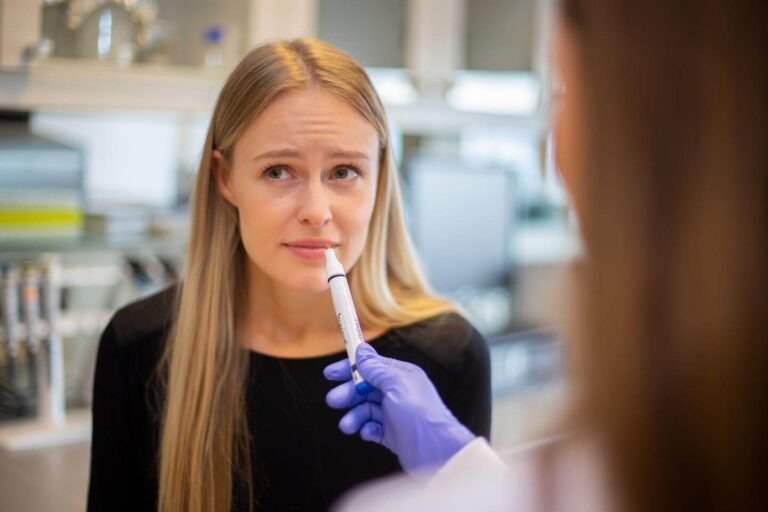
Researchers at Stanford Medicine conducted a study in which more than half the patients who had persistent smell loss improved with platelet-rich blood plasma injections.
Zara Patel MD was there when COVID-19 patients began to report that their sense of odor had been affected. Patel, a professor of otolaryngology in Stanford Medicine, has studied the loss of smell for many years as a viral infection symptom.
As rhinologists, we knew that many viruses could cause loss of taste and smell. “It was almost expected,” said Patel. Patel knew the condition would last for a long time and that there were few treatments available.
In a survey conducted by Patel and co-workers in 2022, approximately 15% of those who had experienced odor loss due to COVID-19 still had problems six months after the initial incident. This is approximately 9 million Americans, and it’s growing. The loss of smell often leads to a loss of taste, as the sense of smell is so important in how we perceive food.
Patel’s research team has now tested a new treatment to treat long-term COVID-19 related smell loss. The injections were made from platelet-rich blood plasma taken directly from the patient. In a 26-person trial, patients who received the treatment had a 12.5 times higher chance of improving than those who received placebo injections. The study was published in the International Forum of Allergy and Rhinology on December 12.
The platelet-rich form of plasma is the liquid part of blood that has been concentrated after removing blood cells and other components. It is rich in growth factors, compounds that help regenerate tissues. It is claimed that platelet-rich blood can be used to treat mild arthritis by injecting it into joints. It also reduces wrinkles on the face and can even regrow hair if injected in the scalp.
Patel was skeptical about such a cure, but intrigued by a recent study that showed platelet-rich-plasma injections are as effective as surgery for treating carpal-tunnel syndrome. This condition is caused by the compression and injury of a nerve at the wrist. She was aware that COVID-19 caused smell loss, which is also a neurological issue. The virus’s long-term effects prevent the nerves in the nasal cavity to regenerate correctly. These nerves are connected to the brain, and they regenerate normally every three to four month.
She said, “It is a nerve regeneration and damage issue.
Stealth Attack
The SARS-CoV-2 does not directly target nerve cells. Instead, it targets supporting cells called sustentaculars cells. These cells have the ACE-2 virus receptor that allows the virus to infect the cells. These cells are important for nerve regeneration. Damage and inflammation to these cells can lead to a long-term loss in function.
Patel already had a small study completed to demonstrate the safety of platelet rich plasma injections into the nasal cavity, when the pandemic struck. She then refocused her plans for an expanded trial on COVID-19 associated smell loss.
All participants must have confirmed previous COVID-19 infection and persistent smell loss that lasted between 6-12 months. The participants had to also have tried other treatments, such as steroid rinses and olfactory conditioning.
Patel explained that he wanted to ensure that the intervention he was studying was not only equivalent or in place of treatments we already do, but also provided benefits above and beyond.
The half of the participants were given platelet-rich Plasma injections every two weeks into deep tissue inside the nasal cavity for six weeks. The other half was given placebo injections, which are saline. The participants and researchers did not know who got what.
The sniff test
Researchers assessed smell abilities using a standard olfactory testing tool known as Sniffin’ Sticks. The test contains a variety of smells (both pleasant (flowers), and horrible (rotten egg), and participants’ ability to distinguish between odors and their strength is scored.
Researchers checked on the participants after three months. The platelet-rich Plasma group scored an average of 6.25 points more than before the treatment. This was 3.67 points higher than the placebo group. The greatest improvement was in the ability to distinguish between different smells, also known as “odour discrimination”. After three months, 56.1% of those in the platelet-rich blood group showed a clinically meaningful improvement, while only 8.3% were in the placebo group.
In an interesting twist, when participants were asked to rate their own ability to smell, they both reported similar improvements. Patel explained that previous studies had found that subjective improvements don’t always correspond with objective improvements.
Patel explained that the improvements seen in the placebo group may be partly due to a placebo, but could also indicate that spontaneous healing can occur even six months later.
Patel stated that COVID-19 brought to light the post-viral loss of smell and perhaps a greater appreciation for how important smell is in our everyday lives. Although this study did no evaluate taste loss the recovery in smell would likely help with the recovery in taste.
She said, “People always tell me that they didn’t realize how important their senses of taste and smell were to their lives until they lost them.” People say that their lives have become gray.
Patel now offers platelet-rich Plasma injections to patients who are not part of the trial.
Patel stated that “our olfactory system can be resilient.” “But, the earlier you make a definitive intervention the more likely you are to see improvement.”
Researchers from UC San Diego have contributed to this study.